
12 Mil vs 20 Mil Wear Layer: Which Vinyl Floor Do You Need?
Pick up a box of vinyl plank and you'll see two thickness numbers. One is in millimeters. The other is in mil. Most shoppers look at the millimeters. The mil number tells you more about how long the floor will keep its look.
That mil number is the wear layer.
What the wear layer does
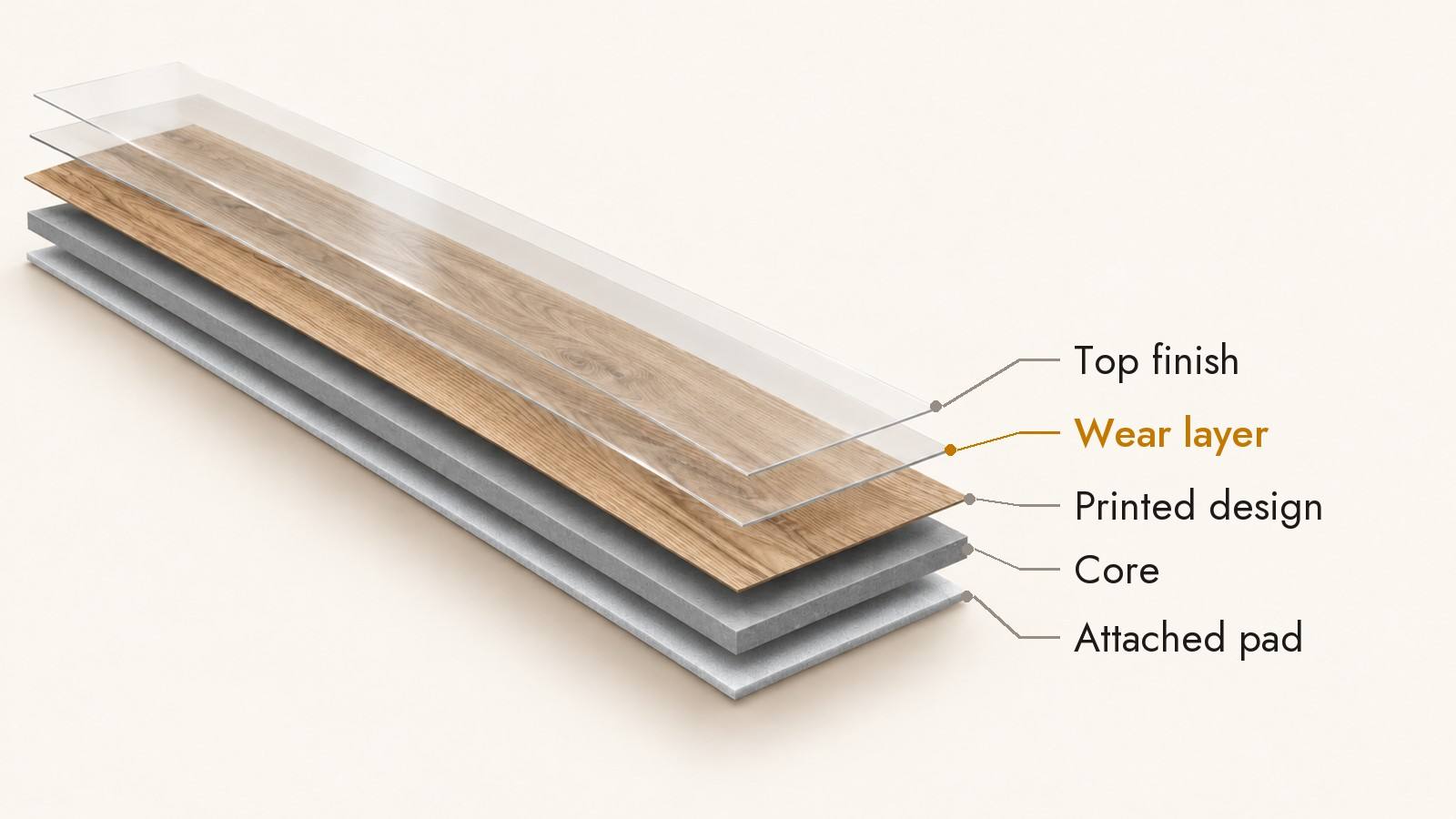
Vinyl plank is built in layers. Near the top sits a printed film with the wood or stone look. The wear layer is the clear coat over that print. It takes the scuffs from shoes, chair legs, pet nails and mopping so the print underneath stays clean.
Once traffic wears through it, the print itself starts to wear. At that point the usual fix is replacing the planks, so the wear layer is the part you want to get right when you buy.
Most wear layers also have a factory finish on top, usually urethane. Some finishes mix in hard particles like aluminum oxide or ceramic beads for extra scratch resistance. The finish also sets the sheen of the floor.
Mil and mm are different measurements
A mil is one thousandth of an inch. A millimeter is about 39 times thicker than that.
- 12 mil is about 0.3 mm
- 20 mil is about 0.5 mm
- 22 mil is about 0.56 mm
The millimeter number on the box is the whole plank: the core, the print, the wear layer and the attached pad if it has one. Plank thickness affects how solid the floor feels underfoot, how quiet it is and how well it rides over small bumps in the subfloor. It says nothing about the wear layer. A thick plank can have a thin wear layer, and a thin plank can have a thick one.
Two floors we carry show the difference. Step on Floors Earth is 5.5 mm thick with a 12 mil wear layer. Step on Floors Solid is 7.5 mm thick with a 20 mil wear layer.
12 mil or 20 mil: which one do you need?
Most homes put one floor through the whole house, so think about your household instead of room by room.
- Under 12 mil: low traffic and tight budgets, like a guest room or a closet.
- 12 mil: most homes, kitchen included. A solid pick for rental units.
- 20 mil: busy homes with big families or large dogs. Also the starting point for stores and offices.
- 28 mil and up: heavy commercial traffic, like hotel hallways.
20 mil is the number the industry treats as the commercial line. Armstrong's spec sheets, for example, list 0.5 mm (20 mil) as the minimum wear layer for commercial use. Most full commercial warranties also ask for at least 20 mil.
Thickness is only part of the story
The finish counts too. MSI, a large flooring manufacturer, points out that the finish can matter as much as the thickness. A 20 mil wear layer with an aluminum oxide or ceramic bead finish can outperform a 28 mil one with a plain urethane finish.
The wear layer won't stop dents. Dents come from heavy weight on a small spot, like a fridge or a piano leg. How well a floor handles that depends more on the core and on a flat subfloor.
Read the warranty. Residential warranties usually run longer than commercial ones. Some warranties leave out scratch and stain damage, so check what's covered before you count on it.
Making it last
One tip we give every customer is to buy furniture pads, the slider kind that let you slide furniture across the floor. Dragging a couch or a table without them is one of the fastest ways to scratch a new floor, no matter how thick the wear layer is.
What we carry
Every vinyl brand collection in our showroom right now has a wear layer between 12 and 22 mil. Thirteen of the 16 are 20 mil or more. You'll find the wear layer listed in the specs on each collection page, next to the plank size and thickness.
Not sure which one fits your home? Tell us who lives there, pets included. We've installed floors for over 30 years. We'll point you to the wear layer your home needs and nothing more. Come see the samples at the showroom, or ask for a free at-home quote and we'll call you back within one business day. We bring the samples to you.
Visit us: 10681 NW 122nd St, Medley, FL 33178
Hours: Mon–Fri 8am–4pm, Sat 8am–1pm, Sun closed
Call: (786) 597-7400 or (305) 343-2816